Showing posts with label Technology. Show all posts

Sunday, October 18, 2026

Tesla's Flying Roadster and the Future Global Car Market


Wall Street Journal - "What Tesla’s Flying Roadster Really Means for the Global Auto Race"

"With a flying sports car, Elon Musk displayed again that he’s America’s biggest dreamer.

...


In many ways, whether it flies or not is besides the point. Unveiling the Roadster with out-of-this-world technology reiterated that Musk has given up designing cars for regular people to drive. He says the Roadster is the last new vehicle Tesla will offer for humans to drive and is betting instead on remaking Tesla as a robotics company.

In effect, Musk is leaving the mainstream car market to the Chinese—who, he has suggested, are so formidable that many Western automakers are unable to compete without government intervention. It’s a telling sign of where things are going for the Western automotive industry."

The Verge - "The Tesla Roadster flew, drove upside down, and hit 60mph in under a second"

Tuesday, April 21, 2026

Who is Satoshi?


New York Times - "My Quest to Solve Bitcoin’s Great Mystery"

"So I decided to ask Mr. Back for the emails’ metadata. Metadata is to an email what an envelope, postmark and seal are to a physical letter: It shows where the email came from, when it was sent and whether it was altered. The copies of Mr. Back’s email exchanges with Satoshi made public during Mr. Wright’s London trial hadn’t included this information.

I didn’t have high hopes the metadata would tell me anything useful because Satoshi had used the Tokyo-registered anonymous email service, which would have masked his I.P. address. Not only that, Satoshi had probably used Tor to connect to the service to further insulate himself. I still wanted to see it, though, on the off chance I could glean some clue.

But when I emailed Mr. Back my request, he did not reply. I wasn’t sure if he was ghosting me or just busy and I didn’t want to spook him by immediately following up, so I waited eight days to send him another email. Again, radio silence.

I had clearly touched a nerve. But why? With the precautions Satoshi had taken, what was there to even hide? Unless Satoshi had made some sort of mistake?"

China and Drones


New York Times - "China Built the World’s Drone Industry. Now It’s Locking Down the Skies."

Saturday, September 13, 2025

The State and Principles of Wikipedia


The Verge - "Wikipedia is resilient because it is boring"
By Josh Dzieza

"Wikipedia is the largest compendium of human knowledge ever assembled, with more than 7 million articles in its English version, the largest and most developed of 343 language projects. Started nearly 25 years ago, the site was long mocked as a byword for the unreliability of information on the internet, yet today it is, without exaggeration, the digital world’s factual foundation. It’s what Google puts at the top of search results otherwise awash in ads and spam, what social platforms cite when they deign to correct conspiracy theories, and what AI companies scrape in their ongoing quest to get their models to stop regurgitating info-slurry — and consult with such frequency that they are straining the encyclopedia’s servers. Each day, it’s where approximately 70 million people turn for reliable information on everything from particle physics to rare Scottish sheep to the Erfurt latrine disaster of 1184, a testament both to Wikipedia’s success and to the total degradation of the rest of the internet as an information resource."

Sunday, April 20, 2025

Global Migration According to Facebook Data


NYT - "To Understand Global Migration, You Have to See It First"

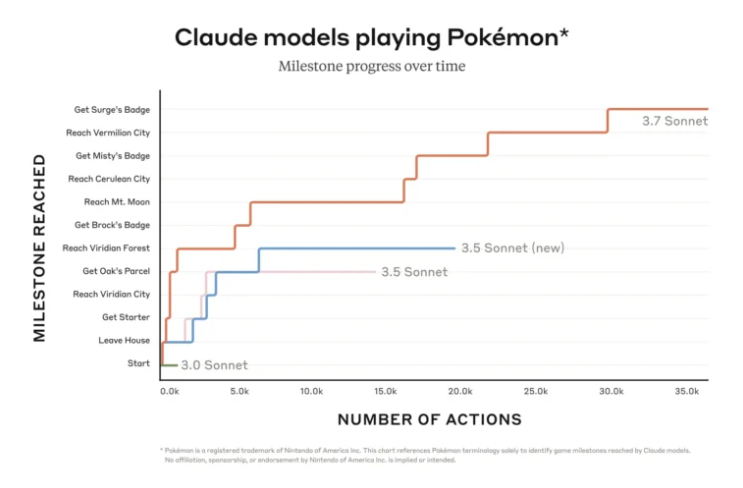
Claude Tries to Beat Pokemon


Ars Technica - "Why Anthropic’s Claude still hasn’t beaten Pokémon"

Robots Run Half Marathon in Beijing


WSJ - "Man Versus Machine as China Shows Off Humanoid Robots in Half-Marathon"

"The human male champion completed the race in one hour, two minutes and 36 seconds, followed by thousands of exhilarated human runners. Some were exhausted, resting nearby to catch their breath.

After two hours, 40 minutes and 42 seconds, Tien Kung Ultra was the first robot to reach the finish line. A large crowd of spectators, including government officials, was eagerly awaiting the robots. Many surrounded Tien Kung Ultra to take photos. The robot maintained its blank expression.

In the end, only Tien Kung Ultra and Little Rascal N2 were able to meet the original cutoff time, and the organizers extended it to 4 hours and 10 minutes so that more robots could finish the race. Little Rascal’s sibling model Xuanfeng Xiaozi N2—or Whirlwind Kid—was among the robots that followed, state media showed. While team Tien Kung stuck with one robot throughout the race, others switched.

Hang Qian, a 29-year-old Beijing resident who ran the half-marathon, said he beat Tien Kung Ultra by about 10 minutes.

“For ordinary people, a half marathon is an extremely challenging sport and everyone gets exhausted. But robots can continue on by replacing the battery,” Hang said"


Thursday, May 16, 2024

Open AI's Library


New York Times - "The Old-Fashioned Library at the Heart of the A.I. Boom"

"Built at Mr. Altman’s request and stocked with titles suggested by his staff, the OpenAI library is an apt metaphor for the world’s hottest tech company, whose success was fueled by language — lots and lots of language. OpenAI’s chatbot was not built like the average internet app. ChatGPT learned its skills by analyzing huge amounts of text that was written, edited and curated by humans, including encyclopedia articles, news stories, poetry and, yes, books.

The library also represents the paradox at the heart of OpenAI’s technology. Authors and publishers, including The New York Times, are suing OpenAI, claiming the company illegally used their copyrighted content to build its A.I. systems. Many authors worry that the technology will ultimately take away their livelihood."

Sunday, April 21, 2024

Unreal Engine Powering Video Games, Movies/Shows, and Industry


New Yorker - "How Perfectly Can Reality Be Simulated?"
By Anna Wiener

"Yet certain things remain hard to simulate. There are multiple types of water renderers—an ocean demands a kind of simulation different from that of a river or a swimming pool—but buoyancy is challenging, as are waves and currents. “The Navier-Stokes equation for fluid simulation is one of the remaining six Millennium Prize Problems in mathematics—it’s unsolved,” Vladimir Mastilović, Epic’s vice-president of digital-humans technology, told me, referring to a set of math problems that have been impervious to human effort. Clouds are tricky. Fabric, which stretches, bends, wrinkles, and billows, often in unpredictable ways, is notoriously difficult to get right. It’s hard to simulate chain reactions. “If I chop down a tree in a forest, there’s a chance that it hits another tree and knocks over another tree, and that splinters and breaks,” Kim Libreri, Epic’s chief technology officer, said. “Getting that level of simulation is very, very hard right now.” Even the smallest human gestures can be headaches. “Putting your hand through your hair—that’s an unbelievably complicated problem to solve,” Libreri said. “We have physics simulation to make it wobble and stuff, but it’s almost at the molecular level.” (In some games, hair is simulated by using cloth sheets with hairlike texture.)

...

Mastilović suggested that MetaHumans could one day be used to create autonomous characters. “So it will not be a set of prerecorded animations—it will be a simulation of somebody’s personality,” he said. He suggested that a simulation of Dwayne (the Rock) Johnson could be fun, and that people could create digital copies of themselves and then license and monetize them. Mastilović’s team often talked about a concept called Magic Mirror: a way to visualize, alter, and explore oneself virtually. “What if I was ten kilos more, ten kilos less?” he said. “What if I was more confident? What if I was older or younger? How would this look on me?” He added, “When things become truly real, photo-real, and truly interactive, that is so much more than the medium we have right now. That’s not a game. That’s a simulation of alternate reality.”

...

In the past decade, Sweeney has become one of the largest private landowners in North Carolina, buying up thousands of acres for conservation. Land conservation struck me as an interesting project for someone in the business of immersive indoor entertainment—incongruous enough that I found it kind of moving. (In a 2007 MTV documentary, Sweeney showed off his garnet collection, some of which was acquired on eBay, and a “climbing tree” in his yard.) When we spoke, I asked Sweeney whether working in games had made him see nature differently. “Natural scenes tend to be the hardest to simulate,” he said. “When you’re standing on a mountaintop, looking out into the distance, you’re seeing the effect of trillions of leaves of trees. In the aggregate, they don’t behave as ordinary solid objects. At a certain distance, trees become sort of transparent. When you look at the real world and see all the areas where computer graphics are falling short of the real world, you tend to realize we have a lot of work yet to do.” He speculated that an efficient, realistic simulation of a forest would require a “geology simulator” and an “ecology simulator,” each with its own complex sets of rules.

...

My friend and I talked about Big Basin, a state park that was home to some of California’s oldest redwoods. A few years ago, it suffered a terrible wildfire. I toured the park shortly after the fires, and found it devastating. But the trees were now trucking along. There was an archival impulse to scanning that I found appealing, even as I wondered if there was an anxiety to it, too. Was there something bleak about creating virtual facsimiles of the natural world while we as a species were in the process of destroying it? Lind, the Quixel co-founder, told me that he had gone on a scanning trip to Malibu in 2018. His team spent a week scanning the Santa Monica Mountains, capturing the texture of the landscape. Two weeks later, the Woolsey fire burned almost a hundred thousand acres of land in the area. “That was actually fairly emotional,” Lind said. “Every scanning expedition, you develop a certain connection with that place.” Still, they had the scans. Today, those images could be scattered across games and movies, in jumbled pastiches of the real thing."

Sunday, April 14, 2024

How WhatsApp Became the World's Default Communications App


Engadget - "How WhatsApp became the world’s default communication app"

By Pranav Dixit