"Some analysts expect the next Grand Theft Auto to sell 40 million copies on PlayStation and Xbox and generate more than $3 billion in revenue in its first four months. Rockstar won’t say how much the game cost to make (though Kolbe did shoot down a popular rumor that it surpassed the $1.5 billion it cost to build Dubai’s Burj Khalifa). But, based on the time and labor involved, it’s almost certainly the most expensive video game ever created."

Showing posts with label Video Games. Show all posts
Showing posts with label Video Games. Show all posts
Sunday, October 18, 2026

Sunday, May 11, 2025
GTA VI Trailer 2
Grand Theft Auto VI is now set to release on May 26, 2026. https://t.co/YgaIn1cYc8 pic.twitter.com/cyeK7GM6Ob
— Rockstar Games (@RockstarGames) May 2, 2025
Sunday, April 20, 2025

Sunday, February 16, 2025
Saturday, February 1, 2025

Sunday, December 15, 2024

Sunday, December 1, 2024
Sunday, April 21, 2024
Unreal Engine Powering Video Games, Movies/Shows, and Industry

New Yorker - "How Perfectly Can Reality Be Simulated?"
By Anna Wiener
"Yet certain things remain hard to simulate. There are multiple types of water renderers—an ocean demands a kind of simulation different from that of a river or a swimming pool—but buoyancy is challenging, as are waves and currents. “The Navier-Stokes equation for fluid simulation is one of the remaining six Millennium Prize Problems in mathematics—it’s unsolved,” Vladimir Mastilović, Epic’s vice-president of digital-humans technology, told me, referring to a set of math problems that have been impervious to human effort. Clouds are tricky. Fabric, which stretches, bends, wrinkles, and billows, often in unpredictable ways, is notoriously difficult to get right. It’s hard to simulate chain reactions. “If I chop down a tree in a forest, there’s a chance that it hits another tree and knocks over another tree, and that splinters and breaks,” Kim Libreri, Epic’s chief technology officer, said. “Getting that level of simulation is very, very hard right now.” Even the smallest human gestures can be headaches. “Putting your hand through your hair—that’s an unbelievably complicated problem to solve,” Libreri said. “We have physics simulation to make it wobble and stuff, but it’s almost at the molecular level.” (In some games, hair is simulated by using cloth sheets with hairlike texture.)
...
Mastilović suggested that MetaHumans could one day be used to create autonomous characters. “So it will not be a set of prerecorded animations—it will be a simulation of somebody’s personality,” he said. He suggested that a simulation of Dwayne (the Rock) Johnson could be fun, and that people could create digital copies of themselves and then license and monetize them. Mastilović’s team often talked about a concept called Magic Mirror: a way to visualize, alter, and explore oneself virtually. “What if I was ten kilos more, ten kilos less?” he said. “What if I was more confident? What if I was older or younger? How would this look on me?” He added, “When things become truly real, photo-real, and truly interactive, that is so much more than the medium we have right now. That’s not a game. That’s a simulation of alternate reality.”
...
In the past decade, Sweeney has become one of the largest private landowners in North Carolina, buying up thousands of acres for conservation. Land conservation struck me as an interesting project for someone in the business of immersive indoor entertainment—incongruous enough that I found it kind of moving. (In a 2007 MTV documentary, Sweeney showed off his garnet collection, some of which was acquired on eBay, and a “climbing tree” in his yard.) When we spoke, I asked Sweeney whether working in games had made him see nature differently. “Natural scenes tend to be the hardest to simulate,” he said. “When you’re standing on a mountaintop, looking out into the distance, you’re seeing the effect of trillions of leaves of trees. In the aggregate, they don’t behave as ordinary solid objects. At a certain distance, trees become sort of transparent. When you look at the real world and see all the areas where computer graphics are falling short of the real world, you tend to realize we have a lot of work yet to do.” He speculated that an efficient, realistic simulation of a forest would require a “geology simulator” and an “ecology simulator,” each with its own complex sets of rules.
...
My friend and I talked about Big Basin, a state park that was home to some of California’s oldest redwoods. A few years ago, it suffered a terrible wildfire. I toured the park shortly after the fires, and found it devastating. But the trees were now trucking along. There was an archival impulse to scanning that I found appealing, even as I wondered if there was an anxiety to it, too. Was there something bleak about creating virtual facsimiles of the natural world while we as a species were in the process of destroying it? Lind, the Quixel co-founder, told me that he had gone on a scanning trip to Malibu in 2018. His team spent a week scanning the Santa Monica Mountains, capturing the texture of the landscape. Two weeks later, the Woolsey fire burned almost a hundred thousand acres of land in the area. “That was actually fairly emotional,” Lind said. “Every scanning expedition, you develop a certain connection with that place.” Still, they had the scans. Today, those images could be scattered across games and movies, in jumbled pastiches of the real thing."
Wednesday, December 13, 2023
Sunday, June 25, 2023

Sunday, May 21, 2023

Saturday, April 15, 2023

Saturday, March 25, 2023


Saturday, December 31, 2022
Video Games in the 2023 Zeitgeist

Axios - "Gaming takes over everything"
Video games will move to the center of the entertainment and pop-culture universe next year.
Why it matters: Streaming services, Hollywood studios, tech giants — even the Saudi government — are racing to capitalize on gaming's vast and ever-expanding popularity, and its lucrative intellectual property.
Gaming movies are the biggest challenger to Hollywood’s superhero hegemony:
- 2023 will bring "The Super Mario Bros. Movie" — a partnership between Nintendo and Illumination, the studio behind the Minions.
- HBO’s first prestige series of 2023, mid-January's "The Last of Us," is an adaptation of a hit PlayStation video game.
- Streaming platforms are preparing a pipeline of games-turned-shows, including adaptations of God of War, Fallout and Assassin's Creed.
The big picture: Gaming is now a $184 billion business, a lucrative IP resource for other media — and the leading edge of the tech industry, both as a business and a harbinger of the industry’s policy battles.
- It's the foundational tech inspiring Meta's costly adventure into virtual worlds.
- It's how Netflix plans to grow its subscriber base, as the streamer tries to become a top video game developer and distributor.
- It's the industry that Saudi Arabia's ruling class has chosen to invest $38 billion in, for the sake of economic diversification and image.
- It's the locus of a growing labor movement in tech, where gaming workers at Activision-Blizzard, Microsoft and elsewhere are moving to unionize.
- It's a recurring target of the Federal Trade Commission. The agency is trying to score a historic antitrust win with its attempted block of Microsoft’s $69 billion bid for Activision — and just secured a $520 million settlement with Epic Games over child purchases run amok in Fortnite.
The games themselves are poised for a blockbuster year, too:
- Mega-releases tied to "Star Wars," "Harry Potter," "Final Fantasy" and "The Legend of Zelda" are slated for the first half of the year.
Reality check: Not every bit of video gaming breathlessness works out.
- E-sports is growing awkwardly. It's still picking up viewers — but its poor profitability is scaring off investors.
- Google, which thought it could be a gaming disruptor, is shutting down its Stadia game-streaming platform in January.
Between the lines: This is what happens when a subculture has been deepening its roots for a half-century.
- Many of the first kids who grew up with gaming become gamer parents, ready to pass gaming to the new generation.
- Power takes notice. Outside elites elbow in.
- Inside, young workers and players look around and see their once-rebellious pastime as an establishment that needs to be challenged.
The bottom line: From World of Warcraft to Wordle, it's a game-lover's world.
Saturday, November 5, 2022
Super Mario Coin Music

The Verge - "Mario’s coin sound has sheet music.The trademarked version of the Super Mario Bros. coin sound apparently has a tempo of 180 beats per minute, a 4/4 time signature, a decrescendo (forte to pianississimo), and a rest at the end. Amazing."
Thursday, December 30, 2021
R.I.P. John Madden

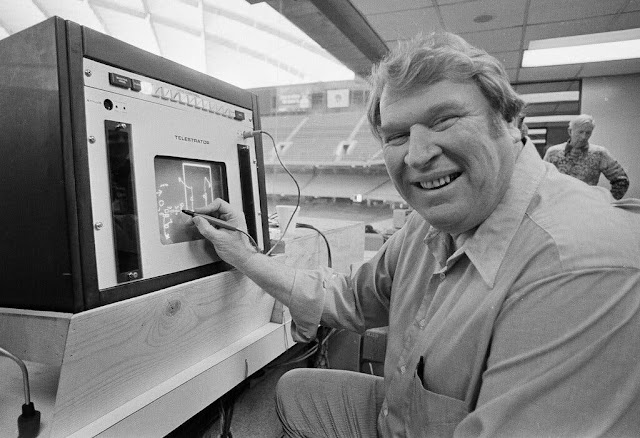
"In his irrepressible way, and with his distinctive voice, Madden left an imprint on the sport on par with titans like George Halas, Paul Brown and his coaching idol, Vince Lombardi. Madden’s influence, steeped in Everyman sensibilities and studded with wild gesticulations and paroxysms of onomatopoeia — wham! doink! whoosh! — made the N.F.L. more interesting, more relevant and more fun for over 40 years."
...
"Rising to prominence in an era of football commentating that hewed mostly toward a conservative, fairly straightforward approach, Madden’s accessible parsing of X’s and O’s added nuance and depth, and also a degree of sophistication that delighted an audience that in some cases tuned in just for him.
Fastidious in his preparation, Madden introduced what is now a standard exercise in the craft — observing practices, studying game film and interviewing coaches and players on Fridays and Saturdays. Come Sundays, he would distill that information into bursts of animated, cogent and often prescient analysis, diagraming plays with a Telestrator, an electronic stylus (whose scribbles and squiggles reflected its handler’s often rumpled appearance) that showed why which players went where."
...
Madden spent his first 15 years in broadcasting at CBS, starting in 1979. There he introduced his Thanksgiving tradition of bestowing a turducken — a turkey stuffed with duck stuffed with chicken — to the winning team. But the three other major networks all came to employ him because, at one point or another, they all needed him.
...
At his core, though, Madden was a coach and by extension a teacher; as he proudly noted in interviews, he graduated with a master’s degree in physical education, a few credits short of a doctorate, from California Polytechnic State University in San Luis Obispo. His unscripted manner translated as well in the Raiders’ locker room — where he guided a cast of self-styled outlaws and misfits to eight playoff appearances in 10 seasons as head coach — as it did in living rooms, man caves and bookstores.
...
As inclusive as he was beloved, Madden embodied a rare breed of sports personality. He could relate to the plumber in Pennsylvania or the custodian in Kentucky — or the cameramen on his broadcast crew — because he viewed himself, at bottom, as an ordinary guy who just happened to know a lot about football. Grounded by an incapacitating fear of flying, he met many of his fans while crisscrossing the country, first in Amtrak trains and then in his Madden Cruiser, a decked-out motor coach that was a rare luxurious concession for a man whose idea of a big night out, as detailed in his book “One Size Doesn’t Fit All” (1988), was wearing “a sweatsuit and sneakers to a real Mexican restaurant for nachos and a chile Colorado.”
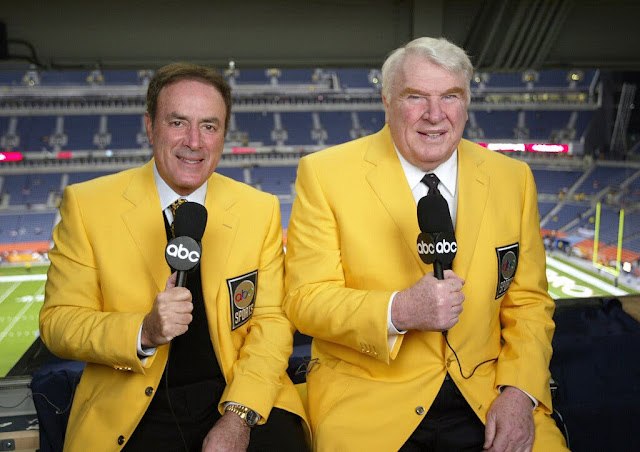
New York Times - "John Madden, America’s Broadcasting Gourmand, Ate Football Up"
"Madden was light years better as a commentator and entertainer than the many analysts who preceded him; it seemed he was calling a different sport altogether. His predecessors in the booth were slower to parse a pass or run and rarely first-guessed plays as deftly as Madden did. The best analysts today — Cris Collinsworth (who replaced him on NBC), Tony Romo and Troy Aikman — aren’t nearly as engaging or amusing.
One benefit of Madden’s highly informed, unpolished, Everyman appeal was his ability to keep viewers watching, or awake, during a blowout. Much of that was Madden — he would have been peerless beside nearly any other play-by-play announcer. But his relationship with his broadcast partner, the terse ex-player Pat Summerall, was part of the magic. Summerall set Madden up like an expert straight man, Bud Abbott to Madden’s Lou Costello."

New York Times - "How John Madden Became the ‘Larger-Than-Life’ Face of a Gaming Empire"
"Because of the limits of computer processing power, Hawkins, who had founded the gaming company Electronic Arts two years earlier, floated the idea of a video game with seven-on-seven football, rather than the 11-on-11 version used in the N.F.L. Madden just stared at him, and said “that isn’t really football,” Hawkins recalled. He had to agree.
“If it was going to be me and going to be pro football, it had to have 22 guys on the screen,” Madden once told ESPN. “If we couldn’t have that, we couldn’t have a game.
The extra years spent developing a more realistic game, which was called John Madden Football and debuted in 1988 for the Apple II computer, paid off. Decades later, the Madden NFL series of video games continues to sell millions of copies annually, has helped turn E.A. into one of the world’s most prominent gaming companies and has left a lasting mark on football fandom and the N.F.L.”
...
From the start, he insisted on realism, instructing developers on details as exacting as how a defensive player should be tackling and which stances linemen should use during certain formations.
The early interaction on the train — Madden had a lifelong fear of flying — showed Hawkins that Madden, despite being affable and entertaining, treated the development process seriously.
“Whatever John says is the final word. He had that kind of presence and the ability to be the commander,” Hawkins said. “It didn’t matter that I was running my company, he’s still going to tell me what to do,” he added with a laugh.
...
Madden’s desire to make the game as accurate as possible came even as he realized the real sport he loved did not always match how other people made their own fun.
“I went crazy one time, in fact, when my son Joe and Michael Frank played,” Madden told Grantland in 2012. “They were on the bus, and the score was 98-96. Neither one of them ever punted. It would be like fourth-and-20, and they’d go for it. I was so pissed off. I said, ‘You’ve got to punt.’ And they never wanted to punt.”
Still, he hoped the video game would help everyday fans learn the intricacies of football plays and more fully enjoy the sport.
Madden peppered the game development process with teachable moments. Once, at Madden’s house, Hawkins teased Madden for never delivering a playbook with 150 plays that could be used in the game, as was required in his contract.
“He basically pulled a 1980 Raiders playbook off a shelf and handed it to me and said, ‘Here you go,’” Hawkins recalled. “‘Here’s the playbook, you go figure it out.’”
Saturday, July 24, 2021
The Metaverse and What are Video Games

The Verge – "Mark in the Metaverse"
"This is a big topic. The metaverse is a vision that spans many companies — the whole industry. You can think about it as the successor to the mobile internet. And it’s certainly not something that any one company is going to build, but I think a big part of our next chapter is going to hopefully be contributing to building that, in partnership with a lot of other companies and creators and developers. But you can think about the metaverse as an embodied internet, where instead of just viewing content — you are in it. And you feel present with other people as if you were in other places, having different experiences that you couldn’t necessarily do on a 2D app or webpage, like dancing, for example, or different types of fitness.
I think a lot of people, when they think about the metaverse, they think about just virtual reality — which I think is going to be an important part of that. And that’s clearly a part that we’re very invested in, because it’s the technology that delivers the clearest form of presence. But the metaverse isn’t just virtual reality. It’s going to be accessible across all of our different computing platforms; VR and AR, but also PC, and also mobile devices and game consoles. Speaking of which, a lot of people also think about the metaverse as primarily something that’s about gaming. And I think entertainment is clearly going to be a big part of it, but I don’t think that this is just gaming. I think that this is a persistent, synchronous environment where we can be together, which I think is probably going to resemble some kind of a hybrid between the social platforms that we see today, but an environment where you’re embodied in it.
So that can be 3D — it doesn’t have to be. You might be able to jump into an experience, like a 3D concert or something, from your phone, so you can get elements that are 2D or elements that are 3D. I’d love to go through a bunch of the use cases in more detail, but overall, I think that this is going to be a really big part of the next chapter for the technology industry, and it’s something that we’re very excited about.
It just touches a lot of the biggest themes that we’re working on. Think about things like community and creators as one, or digital commerce as a second, or building out the next set of computing platforms, like virtual and augmented reality, to give people that sense of presence. I think all of these different initiatives that we have at Facebook today will basically ladder up together to contribute to helping to build this metaverse vision.
And my hope, if we do this well, I think over the next five years or so, in this next chapter of our company, I think we will effectively transition from people seeing us as primarily being a social media company to being a metaverse company. And obviously, all of the work that we’re doing across the apps that people use today contribute directly to this vision in terms of building community and creators. So there’s a lot to jump into here. I’m curious what direction you want to take this in. But this is something that I’m spending a lot of time on, thinking a lot about, we’re working on a ton. And I think it’s just a big part of the next chapter for the work that we’re going to do in the whole industry."

New York Times – "We Need a New Term for Video Games"
"Everyone is trying to get us to come out — or stay in — and play. Seriously. Peloton, Netflix, Zoom, TikTok, Amazon, Apple and Google are all either experimenting or going much bigger into video games.What’s going on?
The straightforward answer is that globally people already spend a lot of time and money on video games, and established game companies and newcomers alike are eyeing all sorts of interactive digital experiments to grab more of our time and money.
I’m excited for this development, even though my own avid video game playing ended in the era of BrickBreaker for the Blackberry. It feels as if we’re in the middle of reimagining both what a “video game” is and what online idle time can be — more engaging and social, perhaps, and a little less passive doomscrolling. (Or I might be reading too much into this. Yeah, it might just be about money.)
Whatever the motivation, games may soon feel inescapable. New features on Zoom — yup, that Zoom — include poker, trivia and mystery games. Peloton, the maker of $2,500 exercise bicycles, is releasing a game that allows people’s pedal power to command a rolling virtual wheel. Netflix this week confirmed that it planned to add video games to its online entertainment service. Facebook, TikTok, Amazon, Apple and Google to varying degrees are pitching us video games or selling game subscriptions. (The New York Times is going bigger into digital games and puzzles, too.)"
Saturday, April 10, 2021
The Origins of Oregon Trail

Watch video here.
"The Oregon Trail" turns 50 this year.
— Casey Common (@CaseyCommon) April 9, 2021
In the fall of 1971, the computer game was created for student teacher Don Rawitsch's 8th-grade history classes at Bryant Junior High in Minneapolis.
In the fall of 1971, Prince was an 8th-grader at Bryant Junior High in Minneapolis. pic.twitter.com/WFO0lSpPIV
Subscribe to:
Posts (Atom)