
New York Times - "Colombia to Sterilize Pablo Escobar’s ‘Cocaine Hippos’"


The Atlantic - "You Should Build a Frog Pond"
@unknowndazza The Full Frod Story! It’s been a crazy journey from 0 to 60k people of Frodrick! Appreciate your ideas and support☺️ #Frodrick #startedfromthebottomnowwehere #FrodHouse ♬ Enemy feat. J.I.D. (from the series Arcane League of Legends) - Imagine Dragons
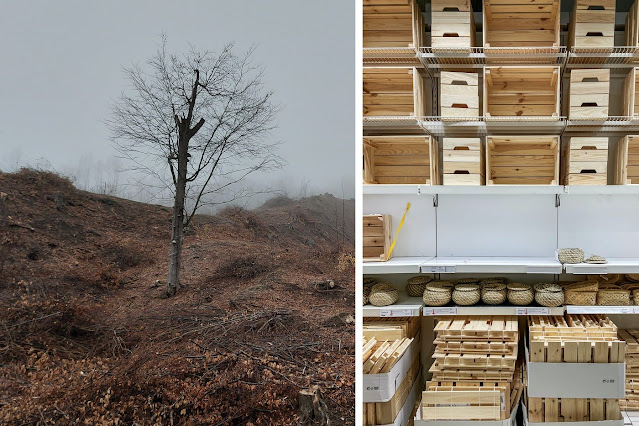
The New Republic - "Ikea’s Race for the Last of Europe’s Old-Growth Forest"
By Alexander Sammon
"In an accident of geography and history, Romania is home to one of the largest and most important old-growth forests left in the world. Its Carpathian mountain chain, which wraps like a seat belt across the country’s middle and upper shoulder, hosts at least half of Europe’s remaining old growth outside Scandinavia and around 70 percent of the continent’s virgin forest. It’s been referred to as the Amazon of Europe, a comparison apt and ominous in equal measure, because of the speed at which it, like the Amazon itself, is disappearing.
Most of Europe was rapidly deforested during the industrial era; less than 4 percent of EU forestland remains intact. Romania, far enough from the continent’s industrial centers and long a closed-off member of the Soviet bloc, remained a shining exception. During the country’s communist period, the government converted the forests to public ownership and kept them off global export markets, enshrining the forest management trends of an ancien regime. The result is that Romania retains some of the rare spruce, beech, and oak forests that qualify as old- or primary-growth, having never been excessively logged, altered by human activity, or artificially replanted.
But the fall of communism in 1989 dissolved one layer of protection for those forests, and the subsequent wave of privatization inaugurated widespread corruption. In 2007, Romania’s entry to the European Union created a massive, liberated market for the country’s cheap, abundant timber and the inexpensive labor required to extract it, conditions that encouraged Austrian timber companies and Swedish furniture firms to set up shop. Succeeding fractious, ineffectual regimes enacted further pro-market reforms and did little to curb corruption; in the final months of 2021, the country’s prime minister designate found himself unable to form a government at all. Add to that the astronomical growth of the fast furniture industry, which particularly relies on the spruce and beech that populate these forests, and the result has been a delirium of deforestation.
There’s one obvious, notable beneficiary of this situation: Ikea. The company is now the largest individual consumer of wood in the world, its appetite growing by two million trees a year. According to some estimates, it sources up to 10 percent of its wood from the relatively small country of Romania, and has long enjoyed relationships with mills and manufacturers in the region. In 2015, it began buying up forestland in bulk; within months it became, and remains, Romania’s largest private landowner."

The Atlantic – "Return the National Parks to the Tribes"
"Thirty-nine years later, Yosemite became the fifth national park. (Yellowstone, which was granted that status in 1872, was the first.) The parks were intended to be natural cathedrals: protected landscapes where people could worship the sublime. They offer Americans the thrill of looking back over their shoulder at a world without humans or technology. Many visit them to find something that exists outside or beyond us, to experience an awesome sense of scale, to contemplate our smallness and our ephemerality. It was for this reason that John Muir, the father of modern conservationism, advocated for the parks’ creation.
More than a century ago, in the pages of this magazine, Muir described the entire American continent as a wild garden “favored above all the other wild parks and gardens of the globe.” But in truth, the North American continent has not been a wilderness for at least 15,000 years: Many of the landscapes that became national parks had been shaped by Native peoples for millennia. Forests on the Eastern Seaboard looked plentiful to white settlers because American Indians had strategically burned them to increase the amount of forage for moose and deer and woodland caribou. Yosemite Valley’s sublime landscape was likewise tended by Native peoples; the acorns that fed the Miwok came from black oaks long cultivated by the tribe. The idea of a virgin American wilderness—an Eden untouched by humans and devoid of sin—is an illusion."


